Thulium Fiber Laser in Endourology: What MultiLASE TFL Changes for Stone Management
11 June 2026 · By Medtech
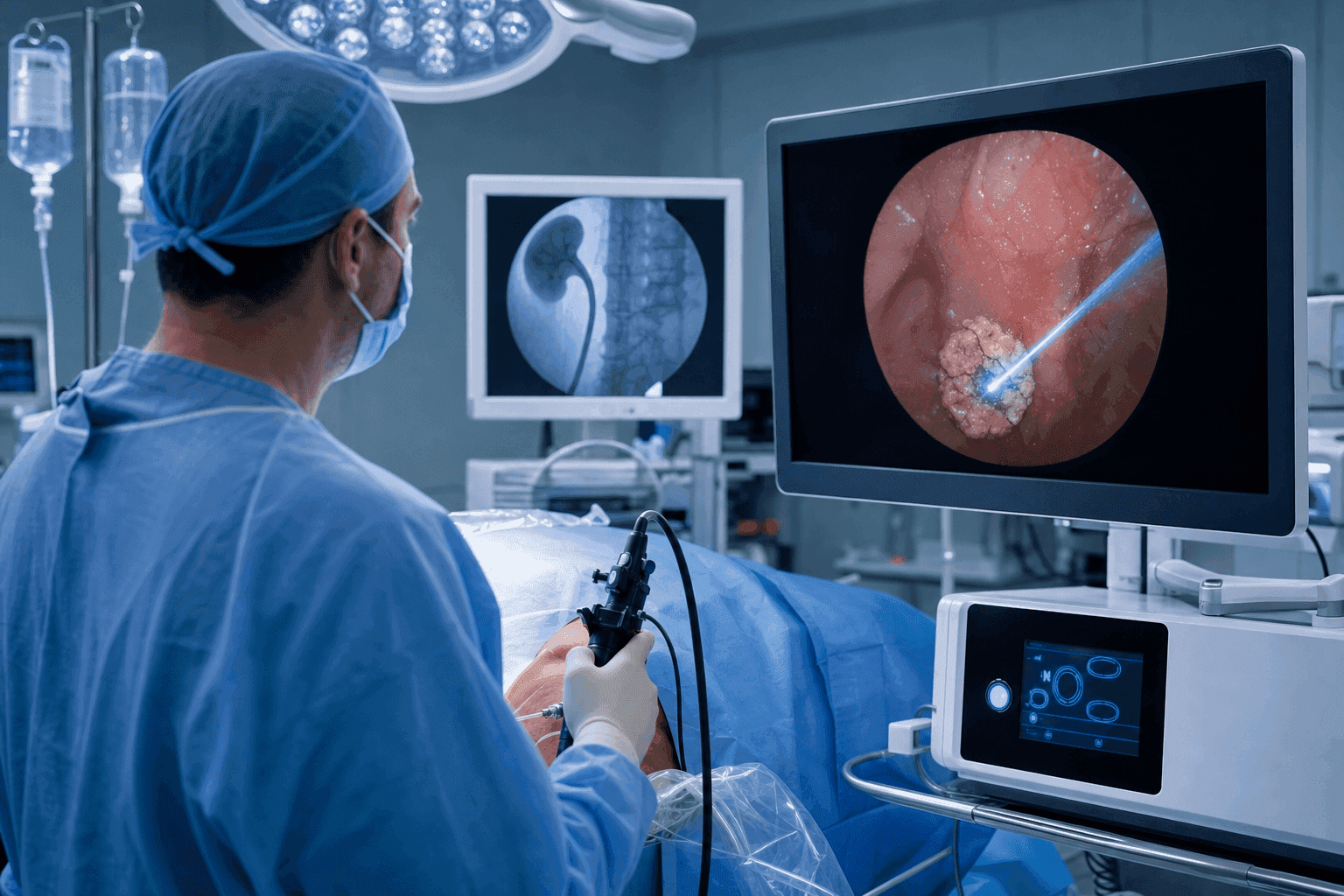
When we hosted our Advancing Endourology event, the technology drawing urologists to the front of the room was the MultiLASE TFL, a thulium fiber laser built for stone work. The interest was practical rather than academic. TFL changes what is achievable on a standard ureteroscopy list, and it does so with hardware that fits real theatres. This article summarises what TFL is, where it outperforms the holmium platforms most units know, and how we prepare a department for its first cases.
The physics, briefly and honestly
Holmium:YAG has been the endourology workhorse for decades. It is a pulsed crystal laser: powerful, proven and demanding, with a large cavity, a heavy electrical draw and substantial cooling requirements in higher-power systems.
A thulium fiber laser generates its energy inside a long doped optical fiber rather than a crystal rod. Three consequences matter at the stone face:
- The emission wavelength sits close to a strong water absorption peak, so more of each pulse is absorbed exactly where it strikes and less energy is wasted around the target.
- The beam can be launched into very small delivery fibers, smaller than holmium typically allows, which preserves irrigation flow and scope deflection during flexible ureteroscopy.
- Pulse energy and frequency can be controlled across a much wider range, including very low energies at very high pulse rates, which is precisely the combination that modern dusting technique depends on.
The machine itself is compact, air cooled, quiet enough to talk over and far less hungry for power than a large holmium cavity. For theatres that were never designed around a big laser system, that is not a small point.
Dusting, fragmentation and what the settings mean
TFL's wide parameter range supports the full spectrum of lithotripsy strategy.
Dusting
Low pulse energy delivered at high frequency turns stone into fine particles intended to wash out or pass spontaneously. Published series report that TFL produces finer dust with less retropulsion than comparable holmium settings, which keeps the stone where the surgeon left it and reduces time spent chasing fragments around the collecting system.
Fragmentation
Higher pulse energies at lower frequency break stones into fragments sized for basket retrieval. The choice between dusting and fragmentation remains a clinical one: stone composition, location, anatomy and the surgeon's retrieval preference all weigh in. TFL simply widens the range within which that choice is free.
We deliberately publish no recipe card here. Optimal parameters depend on the case in front of you, and our application training covers settings logic hands-on rather than by rote numbers.
Where TFL earns its place in the case mix
Units adopting TFL typically feel the benefit first in three places:
- Flexible ureteroscopy for renal stones, where small fibers protect deflection and irrigation, and efficient dusting shortens laser time on larger stone burdens.
- Higher stone-burden patients managed endoscopically, where efficient ablation makes single-session clearance a more realistic goal.
- Mixed lists, because one platform covers dusting, fragmentation and soft tissue applications without reconfiguration between cases.
Shock wave lithotripsy and percutaneous surgery keep their place in a complete stone service, and we supply that spectrum too, including STORZ MEDICAL shock wave systems. The point of TFL is not to retire every other modality. It is to raise what the ureteroscopic arm of your service can do.
Questions theatre managers ask us
Does TFL need theatre modifications? Rarely. The unit is compact, air cooled and runs from a standard supply. A laser safety assessment is still mandatory, and we run it as part of installation, including protective eyewear, signage and local rules with your laser safety officer.
Can our existing scopes and accessories be used? Often, subject to compatibility checks on fibers, sheaths and baskets. We audit the current fleet before quoting a configuration, because a laser matched to tired endoscopes will disappoint everyone.
How long until the team is independent? That varies with case volume and prior laser experience. We commit support until your team signs off as confident, not for a fixed number of cases.
From event demonstration to first case
A laser purchase succeeds or fails in the weeks around go-live. Our support pathway, built on our long-standing Karl Storz endourology distributorship, recognised as Outstanding Distributor for Sub-Saharan Africa in 2023, looks like this.
Before installation
Site assessment, electrical and safety review, and laser safety requirements agreed with your theatre management. Because TFL units are compact and air cooled, this stage is usually short.
Training
Structured application training for surgeons, nurses and technicians: physics, parameter logic, fiber preparation and handling, and troubleshooting. We deliver it through our product specialists, our learning platform and CPD sessions with local accredited providers.
First cases
Our clinical support team stands in theatre for the early lists, helping with settings, fiber management and workflow until the team is comfortable. This is the same in-theatre support model we run across our surgical portfolio.
Afterwards
Preventive maintenance by our Mauritius-based technical team, reliable consumable supply for fibers and accessories, and consignment stock where case volume justifies it.
The complete endourology picture
A laser is one instrument in a wider armamentarium of ureteroscopes, access sheaths, baskets, guidewires and imaging. Matching TFL to high-quality endoscopy is what actually delivers the outcomes the technology promises. You can explore the full range on our Urology portfolio page.
If your unit is weighing a laser upgrade or planning a stone service from scratch, we would rather join the conversation early, while theatre design and training calendars are still flexible. Book a consult through our contact page and we will bring the MultiLASE TFL discussion to your team.
Over 30 years advancing healthcare in Mauritius, Seychelles and Madagascar. Explore the wider Chemtech Group health ecosystem.